
A prospect searches Google for a long question: “best AI SEO agency for Indonesian B2B companies”. In the old search flow, they scanned blue links and chose a result. Now they may read an AI-generated summary first. If your brand is absent from the answer or supporting sources, consideration can happen without you.
Google AI Overview in Indonesia rewards pages that Google Search can understand quickly and summarize safely: crawlable, indexed, answer-first, sourced, and entity-clear. The goal is not to force Google to mention a brand. The goal is to make the page eligible and useful when AI Overview composes an answer.
At Oura Works, this sits in the AEO layer of AI Visibility (OAVF): technical SEO opens crawl access, AEO makes answers extractable, and GEO expands brand visibility across AI engines. For a baseline, start with a Free Mini Audit.
What is Google AI Overview?
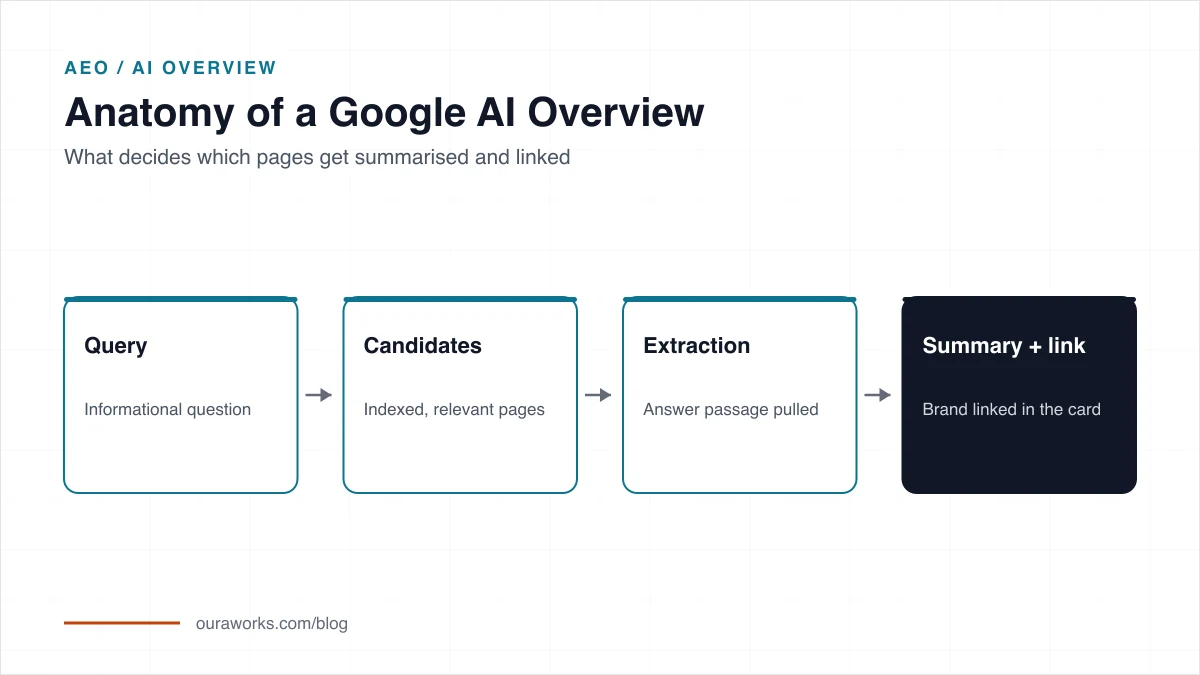
Google explains in AI features and your website that site owners do not need special markup to be considered for AI features in Search. The basics still apply: Google must be able to crawl, index, and understand the content. Preview controls such as nosnippet and max-snippet still matter when you want to limit what can be shown.
So AI Overview optimization is not a separate trick. It is technical SEO plus AEO content discipline: fast pages, crawlable content, direct answers, and claims that can be verified.
Why does AI Overview matter in Indonesia?
In Indonesian B2B, queries such as “AI SEO services for SaaS”, “how to check a brand in ChatGPT”, or “SEO vs AEO vs GEO” do not always end in the first click. Users want a summary before they open a website. That changes the KPI from rankings alone to a mix of impressions, snippet eligibility, brand mentions, and eventual conversion.
Oura’s opportunity is in younger topics: AI SEO services, ChatGPT optimization, AI visibility, and Google AI Overview Indonesia. Competition is lower than the head term SEO agency, while commercial intent is rising.
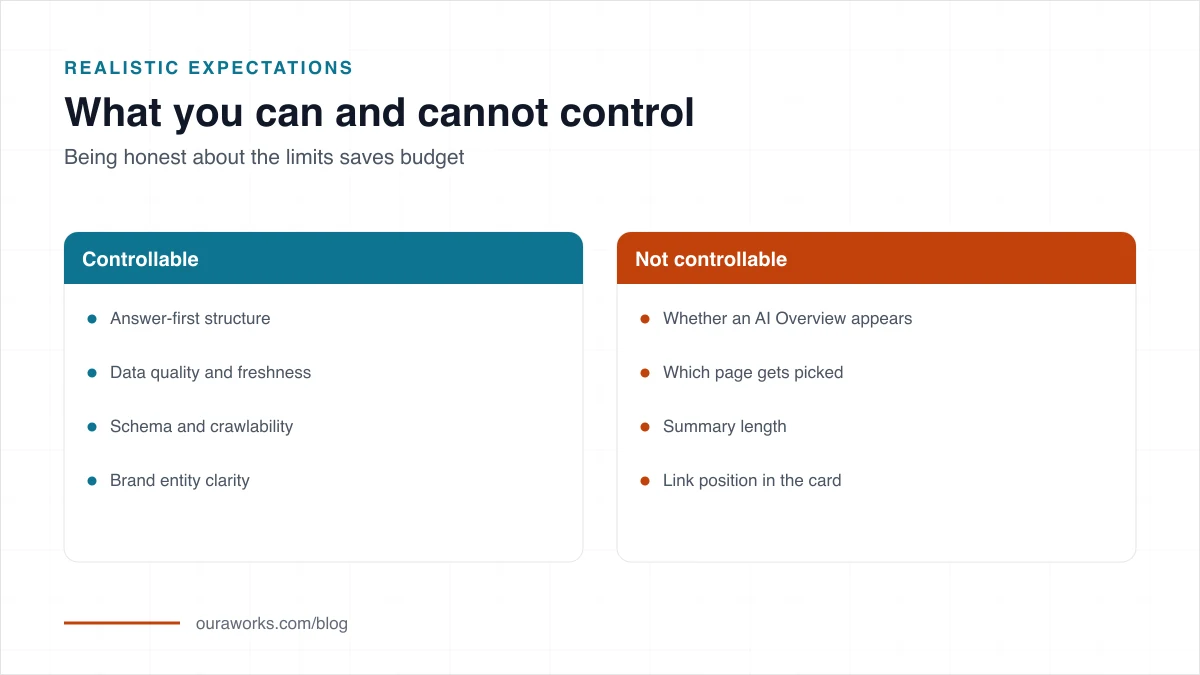
What can and cannot be controlled?
| Area | You control | You do not control |
|---|---|---|
| Crawl | robots.txt, sitemap, internal links, 200 status | Google’s crawl frequency |
| Index | canonical, noindex, page quality | Final indexing decisions |
| Snippet | nosnippet, max-snippet, paragraph structure | Exact text Google chooses |
| Content | 40-80 word answers, tables, sources | Which queries trigger AI Overview |
| Entity | Organization schema, About page, author | External knowledge graph gaps |
Do not sell AI Overview as a guarantee. The healthier position: optimize eligibility conditions and measure signals. That is how Oura frames AI SEO services: not page-one promises, but a measurable SEO and AI visibility system.
9-step checklist for AI Overview readiness
1. Ensure the page is not blocked. Check robots.txt, noindex, canonical, and sitemap. Use Google Search Console after the domain is live. Avoid restricting snippets on educational pages if visibility is the goal.
2. One intent per URL. Do not merge SEO services, ads, web design, and AI visibility into one page. AI Overview needs specific answers, not a multi-intent catalog.
3. Write 40-80 word answers at the start of H2 sections. This helps readers and crawlers understand the core answer without reading the whole article.
4. Use headings as questions. “How do you appear in Google AI Overview?” is more extractable than “Advanced strategy”.
5. Add sourced facts. Major claims need primary sources or clear research. For GEO principles, Princeton GEO found that citation, statistics, and quotation can improve generative visibility in experimental settings.
6. Use comparison tables. Tables help extraction because information is already structured. Use them for SEO, AEO, GEO, ChatGPT, Perplexity, Gemini, and AI Overview comparisons.
7. Clean up entity signals. Add a brand definition in the hero, About page, Organization schema, and real author signals. Do not create fake sameAs links.
8. Connect the cluster. Link to AI Visibility, AI SEO services, what is GEO, and engine-specific articles.
9. Measure manually. Check research queries weekly. Record whether AI Overview appears, which sources are cited, and whether your brand enters the answer ecosystem.
Answer-first section template
Use this pattern for service pages and articles:
| Element | Format | Example |
|---|---|---|
| H2 | User question | How do you appear in Google AI Overview? |
| Paragraph 1 | 40-80 word answer | There is no special button… |
| Evidence | Source/year/data | Google Search Central, GEO research, GSC |
| Detail | Practical steps | Crawl, index, answer-first, internal links |
| CTA | Relevant and light | Free Mini Audit |
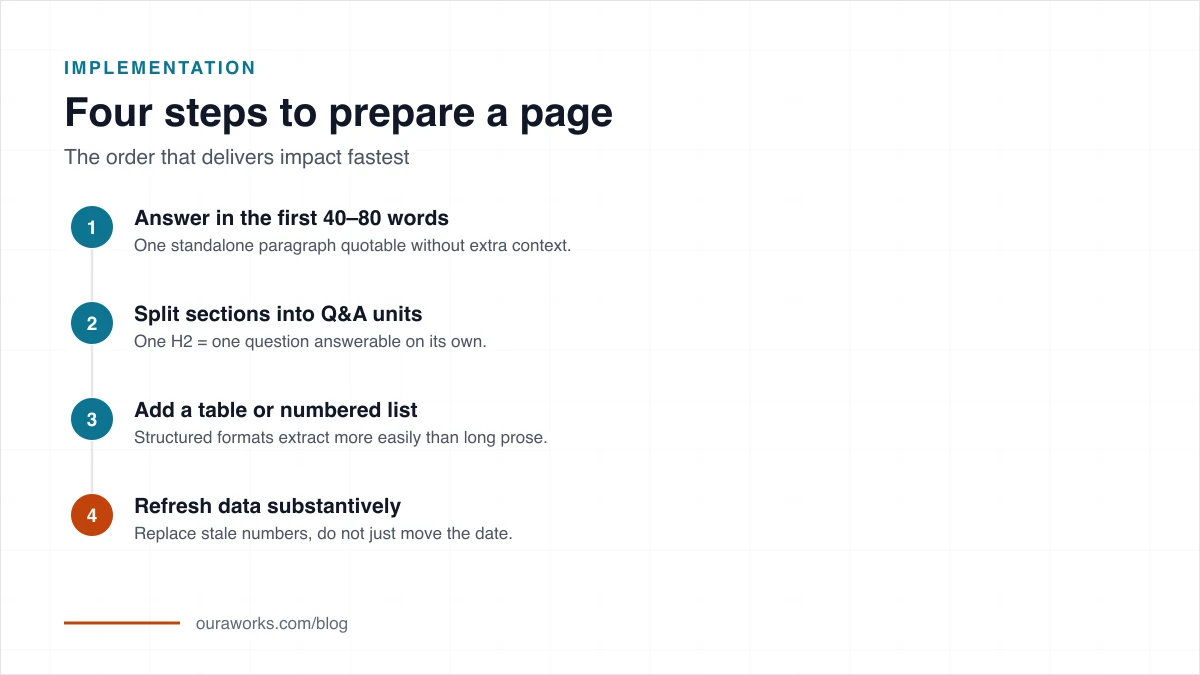
This pattern is not only for Google. It also helps ChatGPT and Perplexity, Claude, and Gemini because every engine needs clear passages that are hard to misquote.
When should you get help?
Oura Works starts with a Free Mini Audit: indexing, page structure, entity signals, and AI visibility opportunities. If the gap is clear, execution moves into OAVF and Oura Atlas so improvements can be tested, not merely published.
References: Google Search Central - AI features and your website; Google Search Central - robots meta tag and data-nosnippet; Princeton GEO research.