
You open a case study, see a big number 12 → 1.2K impressions, and ask: “Is this relevant to my situation?” That is the right question — and it starts with the badge on hub cards and detail page heroes.
Every case study on ouraworks.com uses one of two transparency labels:
- Measured impact — outcomes from real engagements with auditable data
- Target projection — scenarios or targets not yet fully verified as actual results
Two badges to look for
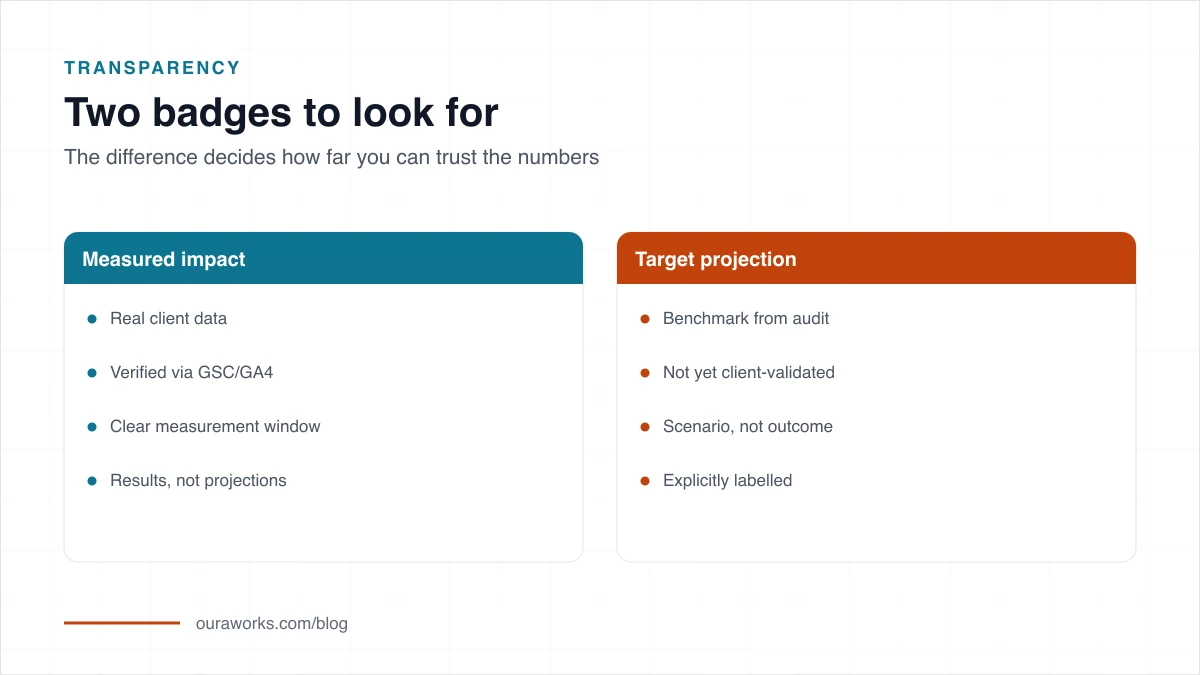
The featured case study on the homepage — brand baru ditemukan with 12 GSC impressions — carries the Measured impact badge and teaches entity foundation and local discovery. Other vertical examples: lima cabang satu peta or SaaS fondasi AI-ready.
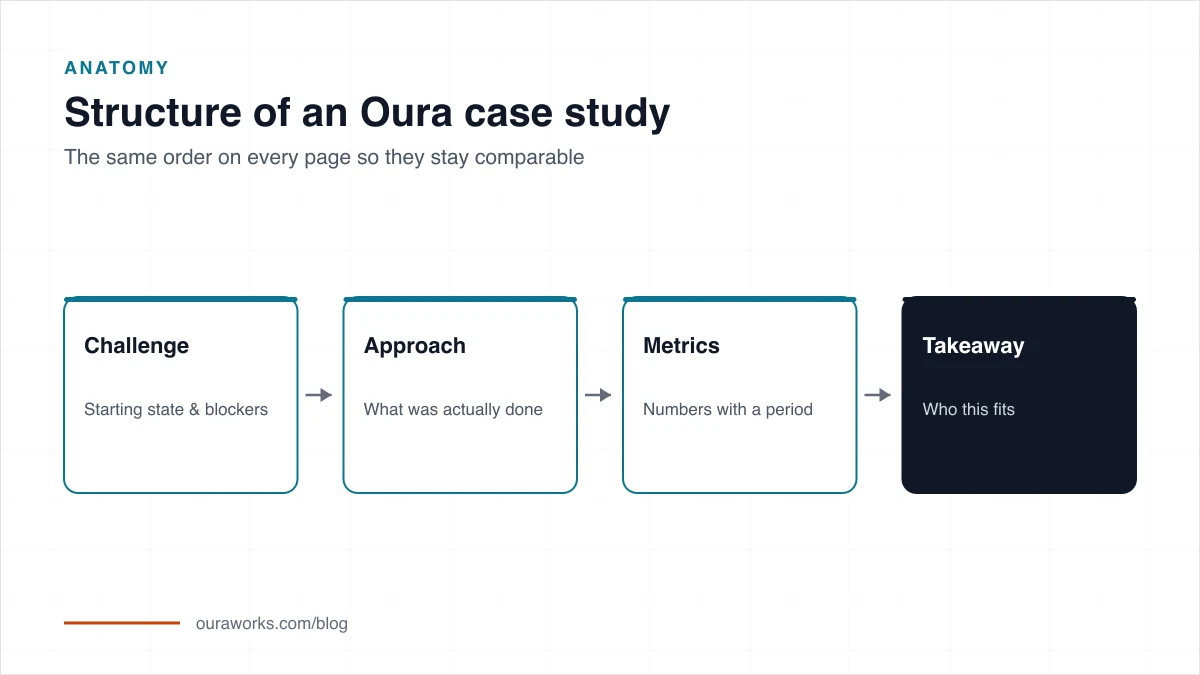
Anatomy of an Oura case study page
Each /studi-kasus/[slug]/ follows the same structure — inspired by global agencies (Seer, Victorious, NoGood):
- Badge — Measured impact or Target projection on hero and hub cards
- Decision question — headline answering “is this story for my situation?”
- Stat strip — 2–3 hero numbers (impressions, AI referral, PageSpeed, etc.)
- Metadata — industry, package, services, duration
- Challenge → Approach → Results — with the Atlas loop in the middle
- Before / After — absolute statements, not just percentages
- Timeline — week/month phases for realistic expectations
- Fit / Not fit — honest when a package is not the right fit
How to judge relevance for your business
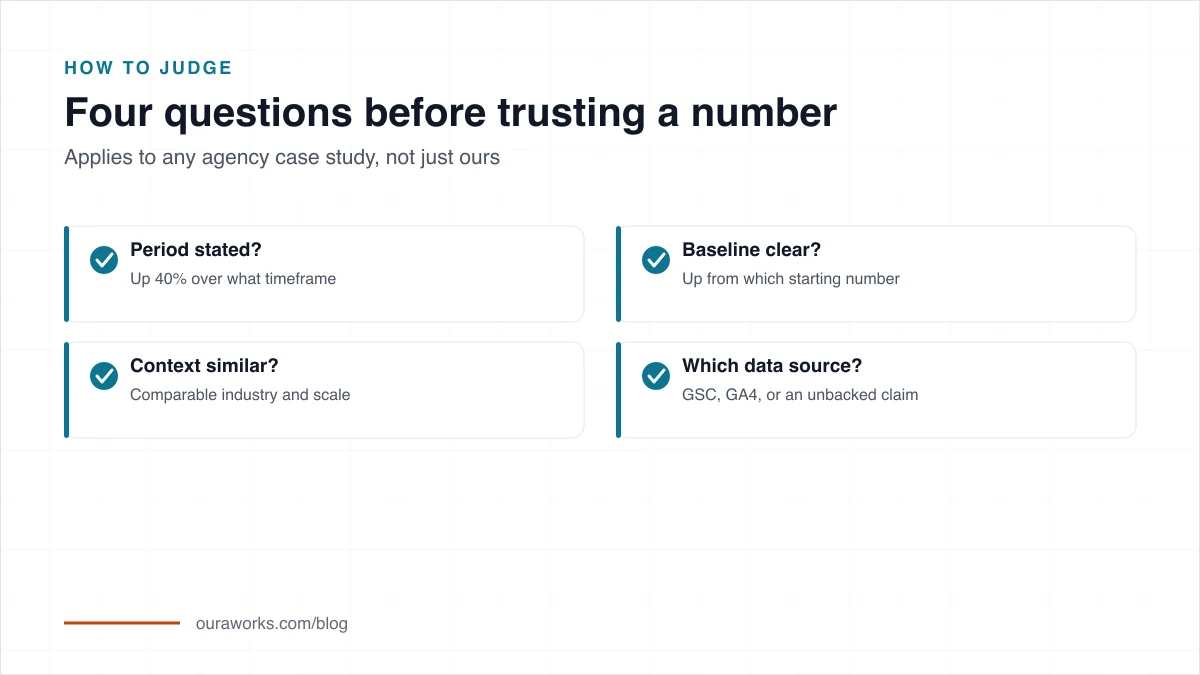
Use a five-minute checklist:
| Question | Why it matters |
|---|---|
| Same badge? | Do not compare Measured impact with Target projection |
| Similar industry & scale? | Local clinic SEO ≠ enterprise B2B SaaS |
| Same package? | Starter = foundation; Growth = volume + OAVF |
| Same starting point? | 12 impressions vs 50K/month need different strategies |
| Solid technical foundation? | GEO on a broken site = waste |
| AI-referral segment in place? | Without measurement, no baseline |
Example: brand baru ditemukan fits SMBs going digital who want to understand foundation direction. lima cabang satu peta is more relevant when you need a multi-location branch pattern.
Testimonials and quotes
Homepage quotes come from clients with publication permission (src/i18n/testimonials.ts). Quotes inside case studies may use anonymized speakers when needed — content still reflects real engagements.
For deeper verbal references, start with a Mini Audit and ask for a redacted sample report relevant to your vertical.
From case study to package decision
The flow we recommend:
- Read 2–3 studies in a similar vertical — note each badge.
- Note the package used and timeline phases.
- Run a Mini Audit — get package recommendations based on your data, not someone else’s story.
- Compare scope on services pages.
Transparency as a product
“Proof, not promises” on about is not a slogan — it is an editorial gate. Measured impact case studies go live when:
- Data is auditable (GSC, GA4, Atlas logs)
- The client agrees to publication (named or anonymized with permission)
- Metrics have consistent before/after
Target projection studies are published when the strategic narrative is clear and target figures are honestly labeled — never disguised as actual outcomes.
Start here
- Browse the case study index
- Read State of AI Search Indonesia 2026
- Book a Free Mini Audit
Oura Works — win on Google, get cited in AI. Real outcomes carry the Measured impact badge; strategic targets are labeled Target projection.