
Healthcare services / SMB
Measured impactMy new website looks great — why is nobody finding us on Google?
New clinic, 3 weeks live — 12 GSC impressions, 0 patients from Google
Oura Starter Read →
An industrial components exporter losing the AI research battlefield. The sales director needed answer-first spec pages citable before buyers send RFQs.
The buying question this story answers Our catalog is complete — why don't buyers researching on AI find our specs before sending an RFQ?
The gist
In B2B manufacturing, PDF catalogs are not discovery assets — structured spec pages citable by AI are. Buyers research first, RFQ second.
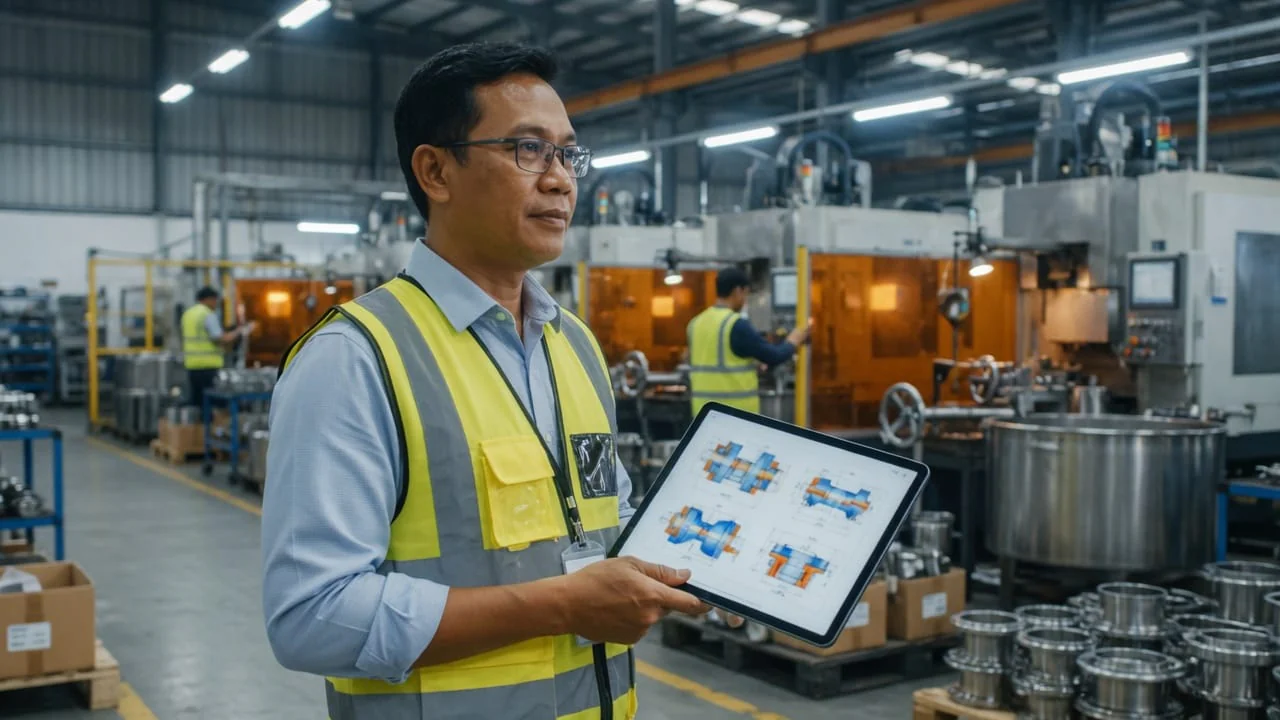
Manufacturing / B2B export
Anonymized client
“European buyers ask ChatGPT before emailing us. They said our specs weren't in the answer — though our PDF catalog is 200 pages.”
Full story
The export sales director received an RFQ from a German buyer — a high-margin product that had only ever drawn inquiries at trade shows. In the email, procurement wrote:
“We shortlisted suppliers via Perplexity using material grade [X] for [application Y]. Your name appeared in the third recommendation — we did not know your firm before.”
It was the first time AI research delivered an RFQ — not the PDF catalog sent hundreds of times and never opened.
In B2B manufacturing, we used to be proud of thick catalogs. 200 pages of specifications. But our own CRM data: 73% of buyers research online before contact — increasingly via ChatGPT or Perplexity, not classic Google keywords.
Buyers don’t search “Indonesia component supplier.” They ask: “Stainless 316L flange for marine application, Asian suppliers?” — AI cites pages with structured spec tables, not PDF.
Taiwan competitors already had that. We had a PDF in the download folder.
Bilingual site with short product pages. PDF catalog on homepage. Trade shows — good leads but no scale. Machine translation — wrong technical terms, engineering buyers closed the tab.
Sales wanted more trade shows. Leadership wanted digital. Deadlock.
12 of 340 SKUs had extractable pages — the rest 150-word marketing paragraphs.
PDF crawl blocked — engines could not read 200 pages.
Competitor gap — not price, but extractability: material grade FAQ, CE/RoHS compliance, dimension tables.
RFQ correlation — web inquiries that converted had product pages 4× longer than those that did not.
Decision: 28 priority SKUs first — high margin, high inquiry, engineering can review. Not all 340 at once.
Engineering reviewed every page — sales could not publish wrong specs.
Typical patterns for B2B export manufacturers. Growth engagement patterns:
This is a field where specifications are content — and content must be machine-readable, not just human-readable in a PDF viewer.
Before Oura
Turning point
Before & after
Measured metrics
structured spec pages
Relative scale for comparison — not absolute units.
The challenge
Industrial components manufacturer, 340 SKUs, 60% export to ASEAN and Europe. 200-page PDF catalog — not indexed. Website had short product pages without structured spec tables. Taiwan and China competitors had per-SKU pages with material grade, compliance, FAQ — appearing in ChatGPT for technical queries. Internal CRM: 73% of buyers researched online before RFQ. Sales lost opportunities with no URL to forward to procurement — only PDF.
The approach
Audit 340 SKUs — prioritize 28 high-margin + high-inquiry products from CRM.
Answer-first spec pages: grade tables, dimensions, compliance, applications, comparisons.
Product + FAQ structured data — extractable for Google and AI.
Migrate PDF catalog to structured HTML — PDF remains, web is canonical for machines.
B2B OAVF: conversational query mapping (material × application × region).
GA4: track AI-referral → RFQ form — channel-to-pipeline correlation.
Execution phases
Months 1–2
28 priority products from margin + inquiry history. Benchmark Taiwan/China competitor pages.
Months 3–5
Bilingual answer-first pages, grade tables, compliance, Product schema. Engineering accuracy review.
Months 6–7
Conversational mapping, AI citation monitoring, GA4 AI-referral → RFQ correlation.
Oura Atlas
Data from GSC & GA4 becomes a brief, execution runs through dry-run and backup, impact is measured — not wild production changes.
Relate?
“Buyers don't read 200-page PDFs. They ask AI: 'material grade X for application Y, Asian suppliers?' We must be in that answer — or we don't get the RFQ.”
“I forward web pages with spec tables to engineering. I never open other suppliers' PDFs.”
Measured impact
structured spec pages
technical queries cited by AI
AI referral in GA4
Explore more
Healthcare services / SMB
Measured impactNew clinic, 3 weeks live — 12 GSC impressions, 0 patients from Google
Professional services / Local B2B
Measured impactServices agency: capable on page 2 — prospects already have a ChatGPT shortlist
First step · free
Start with a Free Mini Audit — we map your fastest path.
Win on Google. Get cited by AI.
Step 1 / 3
1. About you
SEO
3 priorities
GEO
citation gap
AEO
schema check
Industrial components manufacturer, 340 SKUs, 60% export to ASEAN and Europe. 200-page PDF catalog — not indexed. Website had short product pages without structured spec tables. Taiwan and China competitors had per-SKU pages with material grade, compliance, FAQ — appearing in ChatGPT for technical queries. Internal CRM: 73% of buyers researched online before RFQ. Sales lost opportunities with no URL to forward to procurement — only PDF. This story shows how the Oura squad + Atlas handle similar profiles through the Oura Growth package.
This project ran on Oura Growth. Service scope was tailored to Manufacturing / B2B export — see the timeline and approach sections on this page for execution detail.
In B2B manufacturing, PDF catalogs are not discovery assets — structured spec pages citable by AI are. Buyers research first, RFQ second. Figures on this page come from real client data with publication permission (Measured impact badge).
It depends on technical foundation and competition. Technical fixes and quick wins often show in 4–8 weeks; organic momentum and AI referral usually need several months of continuous iteration.
See the sidebar summary — each case study links to the Oura package that ran it. A Mini Audit helps map the realistic tier for your context.